The Five Pillars of Islam are the five basic acts of worship that form the foundation of a Muslim’s faith and practice. They guide Muslims in their relationship with Allah, teach discipline and responsibility, and help build a strong and united Muslim community.
Every Muslim should understand these five pillars because they represent the essential duties of Islamic life.
What Are the 5 Pillars of Islam?
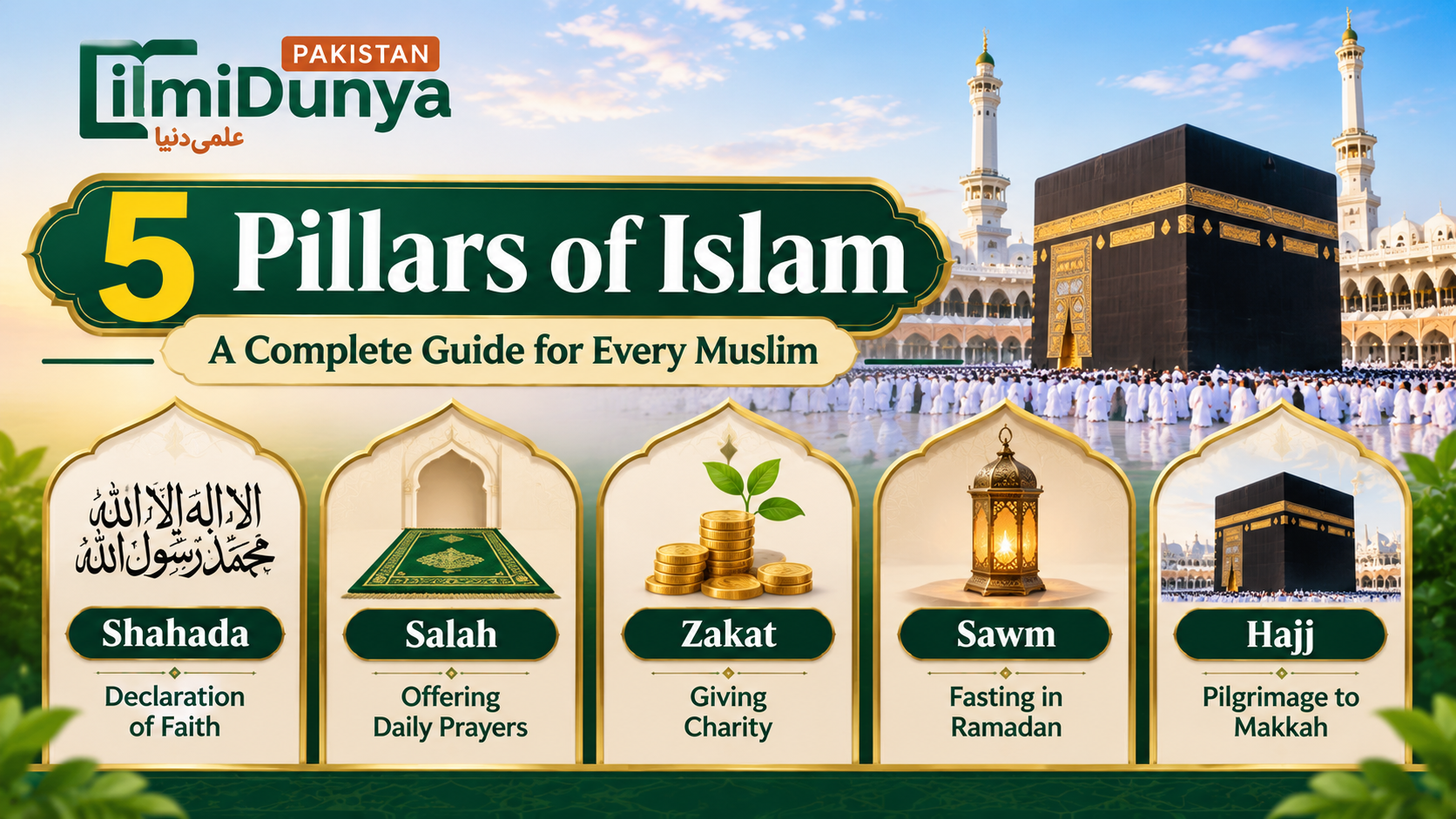
The Five Pillars of Islam are:
- 1Shahada – Declaration of Faith
- 2Salah – Offering Daily Prayers
- 3Zakat – Giving Charity
- 4Sawm – Fasting in Ramadan
- 5Hajj – Pilgrimage to Makkah
The Prophet Muhammad ﷺ explained these five pillars in an authentic Hadith:
“Islam is built upon five: the testimony that there is no god worthy of worship except Allah and that Muhammad is the Messenger of Allah, establishing prayer, giving Zakat, performing Hajj, and fasting in Ramadan.”
Reference: Sahih al-Bukhari 8; Sahih Muslim 16.
1. Shahada – Declaration of Faith
Shahada is the first and most important pillar of Islam. It is the declaration that a person believes in the oneness of Allah and accepts Prophet Muhammad ﷺ as His Messenger.
The Shahada is:
أَشْهَدُ أَنْ لَا إِلَٰهَ إِلَّا اللّٰهُ وَأَشْهَدُ أَنَّ مُحَمَّدًا رَسُولُ اللّٰهِ
Translation: I bear witness that there is no god worthy of worship except Allah, and I bear witness that Muhammad is the Messenger of Allah.
This declaration establishes the foundation of Islamic belief. Muslims worship Allah alone and follow the guidance brought by Prophet Muhammad ﷺ.
2. Salah – Offering Daily Prayers
Salah is the second pillar of Islam. Every adult Muslim is required to offer five daily prayers at their prescribed times.
The five daily prayers are:
- •Fajr – Before sunrise
- •Dhuhr – After midday
- •Asr – Afternoon
- •Maghrib – Just after sunset
- •Isha – Night
Prayer keeps Muslims connected with Allah throughout the day. It teaches discipline, patience, cleanliness, and humility.
Allah says in the Qur’an:
“Indeed, prayer has been decreed upon the believers a decree of specified times.”
Reference: Surah An-Nisa (4:103).
Muslims should make every effort to offer their prayers regularly and with sincerity.
3. Zakat – Giving Charity
Zakat is the third pillar of Islam. It is an obligatory form of charity that eligible Muslims must pay when their qualifying wealth reaches the required threshold (Nisab) and other conditions are met.
For many types of qualifying wealth, the usual Zakat rate is 2.5% after one lunar year of ownership, subject to the relevant Islamic rules.
Zakat helps people in need, reduces poverty, and encourages generosity. It also reminds Muslims that wealth is a trust from Allah.
Allah says:
“And establish prayer and give Zakat.”
Reference: Surah Al-Baqarah (2:43).
Zakat is not simply a financial payment; it is an act of worship that purifies wealth and strengthens society.
4. Sawm – Fasting in Ramadan
Sawm means fasting. It is the fourth pillar of Islam. Muslims fast during the month of Ramadan, abstaining from food, drink, and other things that invalidate the fast from dawn until sunset.
Fasting is not only about avoiding food and water. Muslims should also avoid lying, backbiting, arguments, and sinful behaviour.
Allah says in the Qur’an:
“O you who believe! Fasting is prescribed for you as it was prescribed for those before you, so that you may become mindful of Allah.”
Reference: Surah Al-Baqarah (2:183).
Fasting teaches self-control, patience, gratitude, and compassion for those who experience hunger and hardship.
5. Hajj – Pilgrimage to Makkah
Hajj is the fifth pillar of Islam. It is the pilgrimage to the Holy Kaaba in Makkah, Saudi Arabia.
Every Muslim who is physically and financially able must perform Hajj at least once in their lifetime.
Hajj takes place during specific days of the Islamic month of Dhul-Hijjah. Millions of Muslims from different countries gather to perform the pilgrimage and worship Allah.
Allah says:
“And [due] to Allah from the people is a pilgrimage to the House – for whoever is able to find thereto a way.”
Reference: Surah Aal-e-Imran (3:97).
Hajj teaches equality, unity, sacrifice, patience, and complete submission to Allah.
Why Are the Five Pillars of Islam Important?
The Five Pillars provide Muslims with a practical foundation for their religious lives.
Their importance includes:
- •Strengthening faith: Shahada establishes belief in Allah and His Messenger ﷺ.
- •Building discipline: Salah creates a regular connection with Allah.
- •Helping the needy: Zakat supports people facing financial difficulties.
- •Developing patience: Sawm teaches self-control and gratitude.
- •Promoting unity: Hajj brings Muslims together regardless of their nationality, language, or social status.
By practising these pillars sincerely, Muslims strengthen their faith and improve their daily lives.
Conclusion
The Five Pillars of Islam are the foundation of a Muslim's religious life. They teach belief, worship, generosity, patience, and unity. Every Muslim should learn about these pillars and make sincere efforts to fulfil their obligations.
May Allah guide us to practise Islam sincerely and remain steadfast in our faith. Ameen.