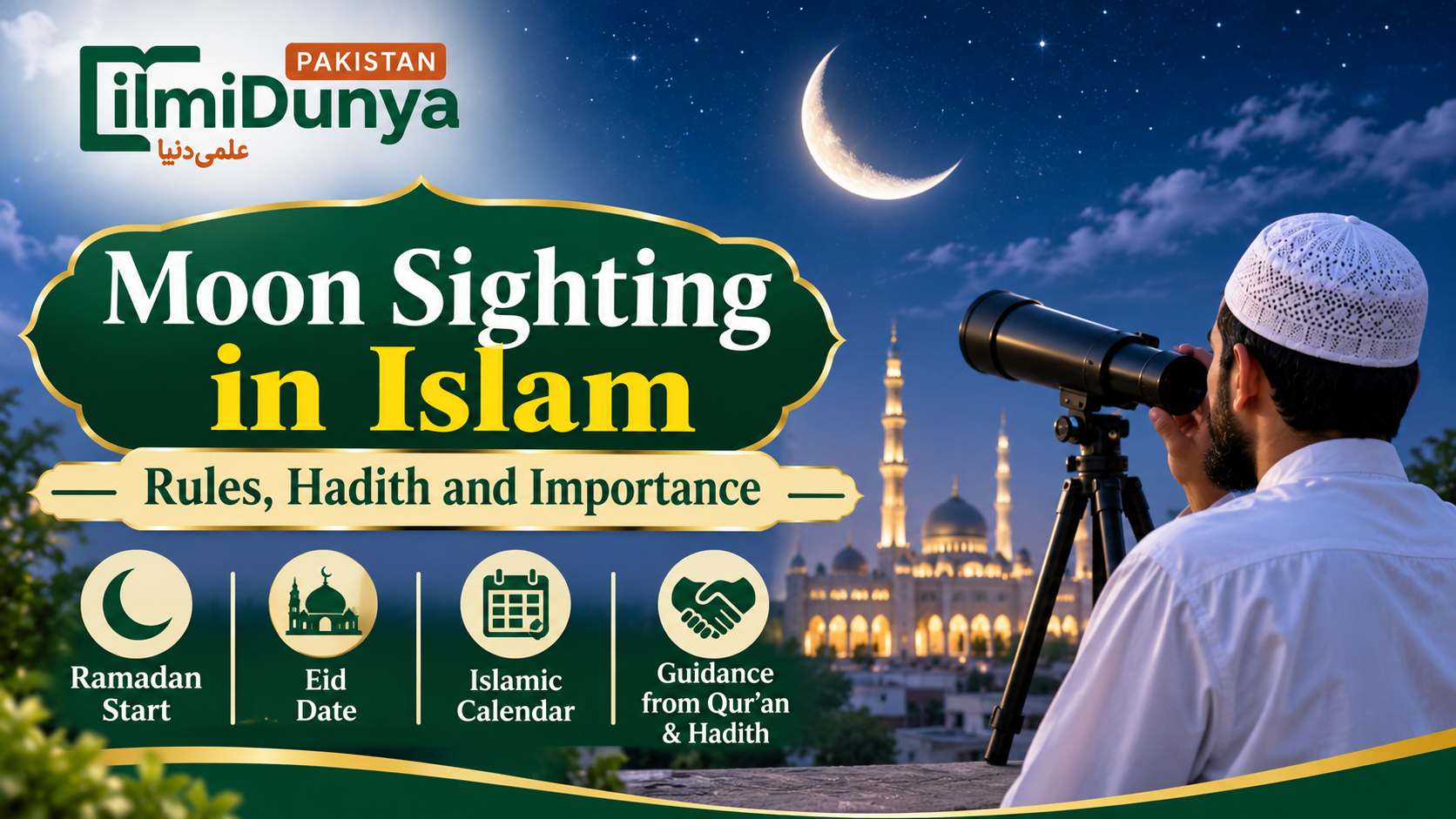
Moon sighting holds great importance in Islam because the Islamic calendar follows the lunar cycle. The beginning and end of important Islamic months, including Ramadan, Shawwal, and Dhul-Hijjah, are connected to the appearance of the new crescent moon.
Muslims around the world look for the crescent moon to determine when to begin fasting, celebrate Eid-ul-Fitr, and observe other important religious occasions.
But what does Islam say about moon sighting? Is it necessary to see the moon with the naked eye? Can Muslims rely on astronomical calculations? Let's explore the guidance of the Qur’an and Sunnah.
What Is Moon Sighting in Islam?
Moon sighting in Islam refers to observing the new crescent moon (Hilal) after the Islamic month has completed 29 days.
The Islamic calendar is based on the lunar cycle, and each month lasts either 29 or 30 days. When the new crescent is sighted after sunset, it marks the beginning of the next Islamic month.
For example:
- •The sighting of the Ramadan crescent marks the beginning of Ramadan.
- •The sighting of the Shawwal crescent marks the end of Ramadan and the beginning of Eid-ul-Fitr.
- •The sighting of the Dhul-Hijjah crescent determines the beginning of the month in which Hajj takes place.
Moon sighting helps Muslims follow the Islamic calendar according to the teachings of Prophet Muhammad ﷺ.
What Does the Qur’an Say About Moon Sighting?
The Qur’an mentions the new moons and explains their importance in determining time and religious occasions.
Allah says:
"They ask you, O Prophet, about the new moons. Say, 'They are a means of determining time for the people and for Hajj.'"
Reference: Surah Al-Baqarah (2:189).
This verse explains that the phases of the moon provide a natural way to determine dates and important occasions, including Hajj.
The lunar calendar is therefore an important part of Islamic worship and daily religious life.
What Did Prophet Muhammad ﷺ Say About Moon Sighting?
Prophet Muhammad ﷺ gave clear instructions on beginning and ending the Ramadan fast.
He said:
"Fast when you see it and break your fast when you see it. If it is obscured from you, then complete the number of Sha'ban as thirty days."
Reference: Sahih al-Bukhari 1909; Sahih Muslim 1081.
This Hadith establishes the importance of observing the crescent moon to determine the beginning and end of Ramadan.
It also explains what Muslims should do when the moon cannot be seen: complete the current month as 30 days.
How Is the Beginning of Ramadan Determined?
Muslims determine the beginning of Ramadan by looking for the new crescent moon on the evening after the 29th day of Sha'ban.
There are two possible situations:
1. If the Ramadan Moon Is Sighted
If the crescent moon is sighted through an accepted method, the next day is the first day of Ramadan, and Muslims begin fasting from dawn.
2. If the Ramadan Moon Is Not Sighted
If the moon cannot be seen because of clouds, poor visibility, or other reasons, Sha'ban is completed as 30 days.
The following day then becomes the first day of Ramadan.
This follows the instruction of Prophet Muhammad ﷺ in the authentic Hadith.
How Is Eid-ul-Fitr Determined Through Moon Sighting?
Eid-ul-Fitr is celebrated on the first day of Shawwal, immediately after Ramadan ends.
On the evening of the 29th day of Ramadan, Muslims look for the Shawwal crescent.
- •If the moon is sighted: The next day is Eid-ul-Fitr.
- •If the moon is not sighted: Ramadan is completed as 30 days, and Eid is celebrated the following day.
Muslims are not permitted to fast on the day of Eid-ul-Fitr.
This system ensures that the end of Ramadan follows the Islamic lunar calendar.
Is Moon Sighting Necessary or Can We Use Astronomical Calculations?
One common question is whether Muslims can use astronomical calculations instead of physically sighting the moon.
Islamic scholars have discussed this matter in detail. The Hadith of Prophet Muhammad ﷺ specifically instructs Muslims to begin and end fasting according to the crescent sighting and to complete 30 days when it is not visible.
Many traditional Islamic authorities use verified moon sightings as the basis for announcing the beginning of Islamic months. Astronomical calculations can also help determine when and where the crescent may be visible, and can assist in evaluating sighting reports.
However, scholars and Islamic authorities differ on the role calculations may play in establishing the beginning of a month. Muslims should follow the recognised religious authority or scholarly guidance in their community.
Why Do Different Countries Celebrate Eid on Different Days?
Sometimes Muslims in different countries celebrate Eid-ul-Fitr or begin Ramadan on different dates.
This can happen for several reasons:
- 1Different moon-sighting locations: The crescent may be visible in one region but not another.
- 2Local sighting practices: Some countries follow local sightings, while others accept sightings from elsewhere.
- 3Different religious authorities: Moon-sighting committees and scholars may follow different approaches.
- 4Weather conditions: Clouds and atmospheric conditions can affect visibility.
These differences are related to the interpretation and application of moon-sighting rules. Muslims should respect legitimate scholarly differences and avoid unnecessary arguments.
Moon Sighting in Pakistan
In Pakistan, the Central Ruet-e-Hilal Committee plays an important role in announcing the beginning of Ramadan, Shawwal, and other Islamic months.
The committee receives moon-sighting reports from different parts of the country and considers the available evidence before making an official announcement.
Local Ruet-e-Hilal committees and witnesses may also contribute to the process.
Muslims in Pakistan generally follow the official announcement to determine the first day of Ramadan and Eid-ul-Fitr.
For current announcements, people should check reliable official sources rather than relying on unverified social media messages.
What Is the Difference Between a New Moon and a Crescent Moon?
The astronomical new moon and the visible Islamic crescent (Hilal) are not exactly the same.
- •Astronomical new moon: This occurs when the Moon is positioned between Earth and the Sun. The illuminated side is generally facing away from Earth, so the Moon is not normally visible.
- •Crescent moon (Hilal): This is the thin illuminated crescent that may become visible after the astronomical new moon, usually shortly after sunset.
This distinction is important because the Islamic month is traditionally established through the sighting of the crescent, not simply the astronomical moment of conjunction.
Why Is Moon Sighting Important for Muslims?
Moon sighting is important because it connects Islamic worship with the lunar calendar established by Allah.
Its importance includes:
- •Beginning Ramadan: It determines when Muslims start their obligatory fasting.
- •Celebrating Eid-ul-Fitr: It establishes the end of Ramadan.
- •Determining Hajj dates: It helps establish the beginning of Dhul-Hijjah.
- •Following the Sunnah: It allows Muslims to practise the guidance of Prophet Muhammad ﷺ.
- •Maintaining the Islamic calendar: It helps Muslims determine important religious dates throughout the year.
Conclusion
Moon sighting is an important part of Islamic life. It helps Muslims determine the beginning of Ramadan, the celebration of Eid-ul-Fitr, and the dates of Hajj.
The Qur’an explains the importance of the lunar phases, while Prophet Muhammad ﷺ instructed Muslims to begin and end fasting according to the crescent moon.
Muslims should follow authentic Islamic teachings, respect recognised religious authorities, and avoid disagreements over legitimate differences in moon-sighting practices.
May Allah guide us to follow the Qur’an and Sunnah and accept our worship. Ameen.