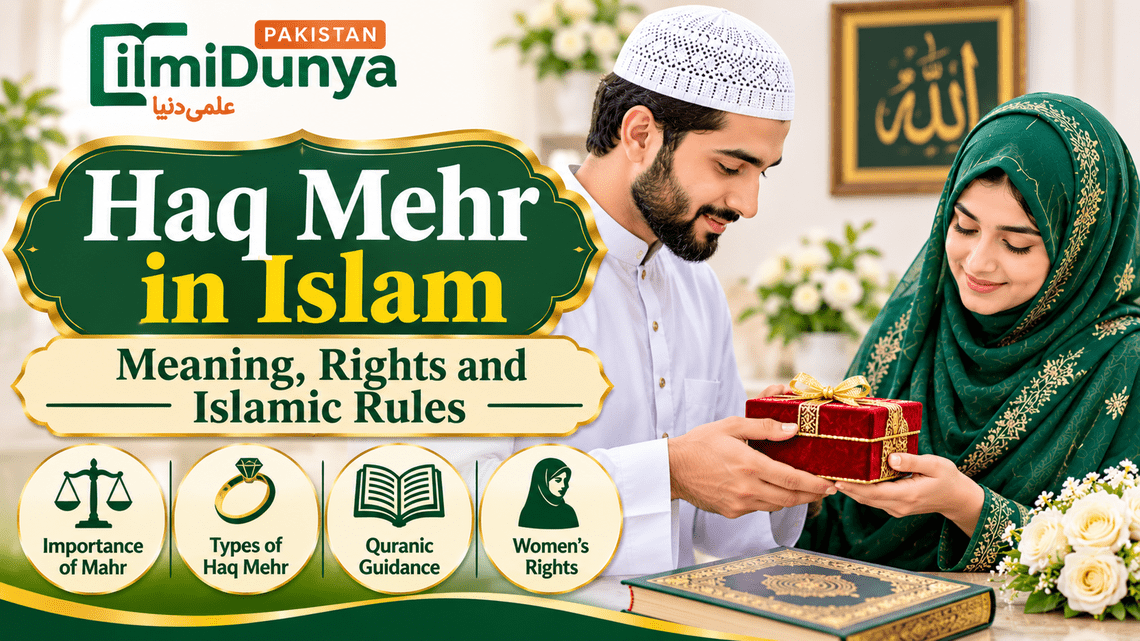
Haq Mehr (حق مہر), also known as Mahr, is an important right given to a woman in Islam at the time of marriage. It is an amount of money, gold, property, or another permissible benefit that the husband gives or promises to give to his wife as part of the marriage contract.
Islam gives great importance to the rights, dignity, and financial independence of women. Haq Mehr is one of the ways Islam protects these rights. It belongs entirely to the wife, and neither her husband nor her family has the right to take it without her free consent.
In this article, we will explain the meaning of Haq Mehr, its importance, types, rules, and what the Quran and Hadith teach us about it.
What Is Haq Mehr in Islam?
Haq Mehr is a mandatory marital right of a Muslim woman. It is given by the husband to his wife as part of the Islamic marriage contract.
Unlike traditional wedding expenses, gifts, or payments made to the bride's family, Haq Mehr belongs directly to the wife.
A husband may give Haq Mehr in different forms, such as:
- •Money
- •Gold or silver
- •Property
- •Another valuable and permissible item
- •A permissible benefit, where recognised by Islamic law
The amount and form of Mahr should be agreed upon by the bride and groom according to Islamic principles.
What Does the Quran Say About Haq Mehr?
Allah clearly commands Muslim men to give women their Mahr.
Allah says in the Holy Quran:
"And give the women [upon marriage] their [bridal] gifts graciously."
Reference: Surah An-Nisa (4:4)
This verse establishes that Mahr is a right of the woman and must be given willingly and respectfully.
The Quran also explains that husbands should not take back the Mahr they have given to their wives simply because they wish to do so.
Allah says:
"And if you want to replace one wife with another and you have given one of them a great amount [in gifts], do not take [back] from it anything."
Reference: Surah An-Nisa (4:20)
These teachings show that Islam protects a woman's financial rights within marriage.
Why Is Haq Mehr Important in Islam?
Haq Mehr is not simply a wedding tradition. It is an important Islamic obligation that carries several meanings.
1. It Is the Wife's Right
Every Muslim woman has the right to receive Mahr from her husband. It is not a gift that the husband can freely cancel after marriage.
2. It Provides Financial Security
Mahr gives a woman something of financial value that belongs to her personally. She can save it, spend it, or use it according to her wishes.
3. It Shows Respect for the Marriage
Mahr is part of the Islamic marriage contract. It reflects the seriousness of the commitment and the husband's responsibility towards his wife.
4. It Protects Women's Financial Independence
Islam gives women ownership of their wealth. A wife is not required to hand over her Mahr to her husband, parents, or in-laws.
What Are the Types of Haq Mehr?
In Islamic marriage, Mahr is commonly divided into two main types according to when it is payable.
1. Mu'ajjal (Prompt Mahr)
Mu'ajjal refers to Mahr that is payable immediately, according to the agreement between the spouses.
It may be paid at the time of Nikah or whenever it becomes due under their agreement.
For example, if the agreed Mahr is Rs. 100,000 and it is payable immediately, the husband should pay it according to the agreed terms.
2. Mu'wajjal (Deferred Mahr)
Mu'wajjal refers to Mahr whose payment is postponed until an agreed future time or event.
For example, a husband and wife may agree that a certain amount will be payable later, such as on a specified date or upon a particular agreed event.
Deferred Mahr remains a debt owed by the husband to his wife. It does not disappear simply because payment has been postponed.
The payment conditions should be clearly written in the Nikah Nama to avoid future misunderstandings.
How Much Haq Mehr Should Be Given?
Islam does not establish one universal amount of Mahr for every marriage.
The amount can depend on the agreement between the spouses, their circumstances, and the applicable rules of Islamic jurisprudence.
The Prophet Muhammad ﷺ encouraged simplicity in marriage and showed that Mahr does not always need to be expensive.
In an authentic Hadith, a man wanted to marry a woman but had very little wealth. The Prophet ﷺ asked him to find something, even an iron ring. When he could not find that, the Prophet ﷺ arranged the matter with what he knew of the Quran.
Reference: Sahih al-Bukhari 5135; Sahih Muslim 1425.
This Hadith demonstrates that Mahr does not have to be extravagant. However, it should be agreed upon properly and should not be treated carelessly.
Can a Woman Forgive Her Haq Mehr?
Yes. A woman may willingly forgive all or part of her Mahr.
Allah says:
"But if they give up willingly to you anything of it, then take it in satisfaction and ease."
Reference: Surah An-Nisa (4:4)
This verse makes an important point: the wife must give up her Mahr willingly.
Her husband cannot force her to forgive it. Pressure, threats, emotional blackmail, or family interference should not be used to take away her right.
If she freely chooses to forgive some or all of it, that is her decision.
Can a Husband Refuse to Pay Haq Mehr?
No. Once Mahr becomes due, the husband is responsible for paying it.
If it is prompt Mahr, it should be paid according to the agreed terms. If it is deferred, it remains an obligation until it is paid or the wife willingly forgives it.
A husband should not make promises about Mahr without intending to fulfil them.
It is important for couples to discuss the amount and payment conditions clearly before or during Nikah.
What Happens to Haq Mehr After Divorce?
Haq Mehr remains an important financial right even if the marriage ends in divorce.
The amount due can depend on the circumstances of the divorce and the stage of the marriage.
The Quran provides guidance on different situations:
- •Before consummation and when Mahr was specified: Surah Al-Baqarah (2:237) explains that half of the specified Mahr is generally due, unless the wife willingly gives it up or the husband chooses to pay the full amount.
- •Before consummation and when no Mahr was specified: Surah Al-Baqarah (2:236) discusses giving a suitable provision according to one's means.
- •After consummation: The wife is generally entitled to her full agreed Mahr, subject to the applicable Islamic legal rules and any relevant circumstances.
A specific divorce case should be discussed with a qualified Islamic scholar because details can vary according to the circumstances and school of jurisprudence.
Is Haq Mehr Different from Dowry?
Yes. Haq Mehr and dowry are two different things.
| Haq Mehr | Dowry |
|---|---|
| Given by the husband to the wife | Traditionally provided by the bride's family in some cultures |
| An Islamic marital right | Not an Islamic requirement |
| Belongs to the wife | May be demanded or controlled by others |
| Part of the marriage obligation | A cultural practice |
Islam does not require the bride's family to pay the groom or his family for the marriage.
Demanding dowry as a condition of marriage is contrary to the spirit of fairness and respect taught by Islam.
What Should Be Written in the Nikah Nama?
The Nikah Nama should clearly mention:
- 1The total agreed amount of Haq Mehr.
- 2How much is prompt and how much is deferred.
- 3The form of payment, such as cash, gold, or property.
- 4Any agreed conditions regarding when deferred Mahr becomes payable.
Both spouses should understand the terms before signing the marriage contract.
A clear written agreement can prevent disputes and protect the wife's rights.
Conclusion
Haq Mehr is an important right of every Muslim woman in Islamic marriage. It is not a payment to the bride's family or merely a wedding formality. It belongs to the wife and represents an obligation that the husband must respect.
The Quran clearly commands husbands to give Mahr graciously and protects women from being deprived of their rights.
Muslim families should make marriage simple, avoid unnecessary financial demands, and ensure that every woman's right to Haq Mehr is respected.
May Allah guide us to follow the Quran and Sunnah, fulfil our responsibilities, and protect the rights of women. Ameen.