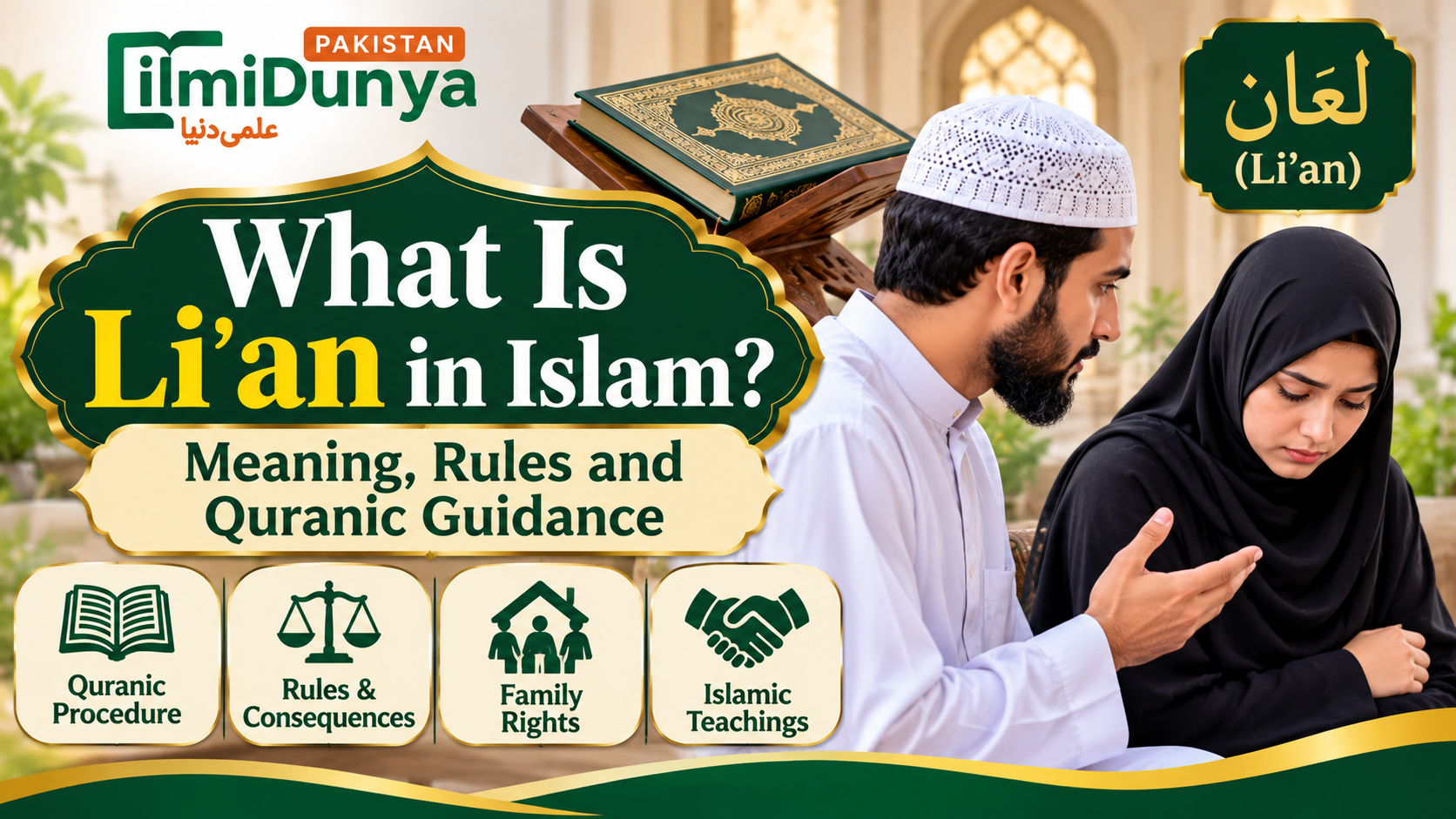
Li'an (لعان) is a specific Islamic legal procedure between a husband and wife when the husband accuses his wife of adultery but does not have the four witnesses normally required to establish the accusation.
Islam provides this procedure to address such a serious allegation through solemn oaths. It protects the rights of both spouses and prevents accusations from being treated as proven merely because one person makes a claim.
The rules of Li'an are explained in the Holy Quran, particularly in Surah An-Nur (verses 6–9). Understanding this concept helps Muslims learn about Islamic family law, justice, and the importance of protecting people's honour.
What Does Li'an Mean in Islam?
The Arabic word Li'an (لعان) is related to the word La'n, meaning curse.
In Islamic terminology, Li'an refers to a formal exchange of sworn testimonies between a husband and wife when the husband accuses his wife of adultery but cannot produce the required witnesses.
The husband makes four oaths that he is telling the truth, followed by a fifth oath invoking Allah's curse upon himself if he is lying.
The wife may respond with four oaths declaring that her husband is lying, followed by a fifth oath invoking Allah's wrath upon herself if he is telling the truth.
This procedure is established in Surah An-Nur, verses 6–9.
What Does the Quran Say About Li'an?
Allah has explained the procedure of Li'an in the Holy Quran:
Surah An-Nur (24:6–7):
The Quran explains that when a husband accuses his wife and has no witnesses except himself, his testimony consists of four oaths by Allah that he is telling the truth. His fifth oath invokes Allah's curse upon him if he is lying.
Surah An-Nur (24:8–9):
The Quran then explains that the wife can avert the prescribed punishment by making four oaths by Allah that her husband is lying. Her fifth oath invokes Allah's wrath upon her if her husband is telling the truth.
These verses establish the Islamic procedure for dealing with this particular situation.
Reference: Surah An-Nur (24:6–9).
Why Was Li'an Established in Islam?
Islam places great importance on protecting people's honour and preventing false accusations.
Normally, an accusation of adultery requires four witnesses under Islamic law. However, a husband may claim that he witnessed something involving his own wife but cannot produce four witnesses.
This creates a specific legal situation involving the rights of both spouses.
Li'an provides a procedure for addressing this situation without treating the husband's accusation as automatically proven or leaving the wife without an opportunity to respond.
It also reminds both spouses that making false statements under oath is an extremely serious matter.
What Is the Procedure of Li'an?
The procedure is based on the instructions in Surah An-Nur (24:6–9).
It involves the following stages:
1. The Husband Makes Four Oaths
The husband swears by Allah four times that he is truthful in his accusation against his wife.
These are formal testimonies, not ordinary statements made during an argument.
2. The Husband Makes the Fifth Oath
In the fifth testimony, the husband invokes the curse of Allah upon himself if he is among those who are lying.
3. The Wife Is Given an Opportunity to Respond
The wife can respond to the accusation through her own sworn testimonies.
She is not automatically considered guilty simply because her husband has accused her.
4. The Wife Makes Four Oaths
The wife swears by Allah four times that her husband is lying in his accusation.
5. The Wife Makes the Fifth Oath
In her fifth testimony, she invokes the wrath of Allah upon herself if her husband is telling the truth.
This completes the Quranic sequence of mutual oaths.
Important: Li'an is a formal Islamic legal matter. It is not something a husband and wife should attempt privately or independently. Its application, validity, and legal consequences require a qualified judicial or religious authority and depend on the relevant school of Islamic jurisprudence and applicable law.
What Happens After Li'an?
Li'an has serious legal consequences for the marriage and family relationship.
1. Separation Between Husband and Wife
Authentic Hadith reports describe Prophet Muhammad ﷺ separating a husband and wife after they completed Li'an.
This is narrated in Sahih al-Bukhari 5313 and 5314.
The precise legal mechanism and some details of the separation have been discussed differently by Islamic jurists.
2. The Accusation Is Not Treated as Ordinary Proof
The procedure does not mean that the wife's guilt has been independently established through four witnesses.
Rather, it is a special legal process established by the Quran for a specific marital situation.
3. The Question of a Child's Lineage
Li'an can also arise in a situation where a husband denies that a child belongs to him.
Sahih al-Bukhari 5315 reports a case in which the Prophet ﷺ separated the spouses and attributed the child to the mother after Li'an.
The rules concerning parentage, inheritance, and legal status require careful application by qualified scholars and legal authorities.
What Is the Difference Between Li'an and Ordinary Divorce?
Li'an and ordinary divorce are not the same.
| Li'an | Ordinary divorce |
|---|---|
| Involves a specific accusation between spouses | Ends a marriage through a recognised form of divorce |
| Based on sworn testimonies described in the Quran | Does not require mutual sworn testimonies |
| Has special legal consequences | Follows the rules of Islamic divorce |
| Requires formal legal consideration | Has its own Islamic legal requirements |
Li'an is therefore a distinct legal procedure rather than simply another name for divorce.
Can a Husband Accuse His Wife Without Proof?
Islam strongly warns against making accusations of adultery without proper evidence.
Allah says:
"And those who accuse chaste women and then do not produce four witnesses—lash them with eighty lashes and do not accept their testimony ever after."
Reference: Surah An-Nur (24:4).
The Quran provides the special Li'an procedure for accusations made by husbands against their wives when they have no witnesses other than themselves.
This demonstrates that accusations involving a person's honour must be handled through proper legal procedures, not anger, suspicion, or public humiliation.
What Can Muslims Learn from the Teachings of Li'an?
The teachings of Li'an offer several important lessons:
- •Justice matters: Serious accusations must be addressed through proper evidence and legal procedures.
- •Honour must be protected: Islam does not permit people to spread accusations carelessly.
- •Both spouses have rights: The wife is given an opportunity to respond to her husband's accusation.
- •Words have consequences: Swearing falsely in Allah's name is a serious matter.
- •Family disputes require wisdom: Sensitive marital matters should not be handled through anger or public arguments.
Conclusion
Li'an is a special legal procedure in Islam established to address accusations of adultery between husband and wife when the husband cannot produce the required witnesses.
The Quran explains the mutual oaths in Surah An-Nur (24:6–9), while authentic Hadith reports provide examples of how the procedure was applied during the time of Prophet Muhammad ﷺ.
The teachings of Li'an remind Muslims that justice, truthfulness, and protection of human dignity are essential in family matters.
May Allah guide us towards truth, protect families from injustice, and help us follow the teachings of the Quran and Sunnah. Ameen.