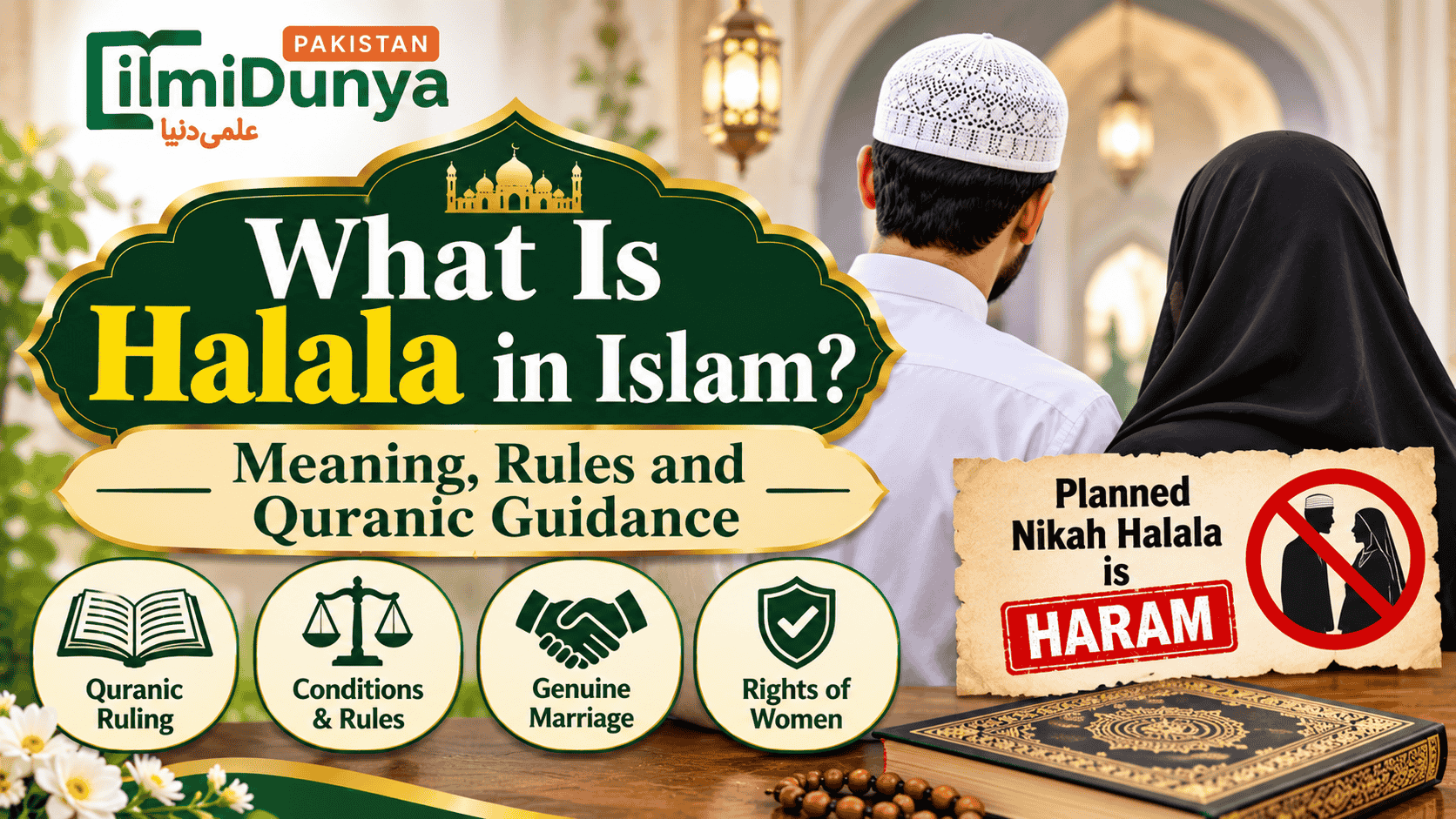
Halala (حلالہ), commonly discussed in connection with Islamic divorce, refers to the conditions under which a woman may remarry her former husband after an irrevocable third divorce.
A common misunderstanding is that Islam allows a temporary or pre-arranged marriage simply to make a woman lawful again for her first husband. This is not the Islamic rule. A marriage arranged solely for this purpose, often called Nikah Halala, is condemned in Hadith.
The Quran explains the relevant rule in Surah Al-Baqarah (2:230). Understanding this topic requires distinguishing the Quranic condition for remarriage from the prohibited practice of deliberately arranging a temporary marriage.
What Does Halala Mean in Islam?
The word Halala comes from the Arabic root related to something becoming lawful or permissible.
In the context of Islamic divorce, people commonly use the term for the situation in which a woman, after an irrevocable third divorce, may become eligible to marry her former husband again under specific conditions.
Islamic teachings do not describe this as a planned or temporary arrangement. Instead, the woman must enter into a genuine marriage with another man, with the intention of having a real marital relationship.
If that second marriage later ends through divorce or the husband's death, she may be eligible to marry her former husband again, provided all Islamic requirements are fulfilled.
What Does the Quran Say About Halala?
The relevant guidance is found in Surah Al-Baqarah, verse 230.
Allah says:
"And if he has divorced her [for the third time], then she is not lawful to him afterward until she marries a husband other than him. And if he divorces her, then there is no blame upon them if they return to each other, provided they think they can keep the limits of Allah."
Reference: Surah Al-Baqarah (2:230).
This verse explains that after the third divorce, the former husband cannot simply take his wife back or marry her again through a new marriage contract.
A subsequent genuine marriage must take place, and it must end naturally through divorce or the second husband's death before the former spouses can consider marrying each other again.
What Are the Conditions for Remarrying the First Husband?
The Quranic rule involves several important conditions.
1. A Genuine Third Divorce Must Have Taken Place
The rule applies when the marriage has ended through a legally effective third divorce.
However, the details of how divorces are counted can differ among Islamic schools of jurisprudence and legal systems. A particular case should be reviewed by a qualified scholar rather than assuming that every statement of three divorces has the same legal effect.
2. The Woman Must Enter Into a Genuine Second Marriage
The woman must marry another man through a valid Islamic marriage contract.
The second marriage must be a real marriage, not an arrangement made simply to enable her to return to her former husband.
3. The Second Marriage Must Be Consummated
A marriage contract alone is not sufficient for this condition.
An authentic Hadith explains that the woman must have marital relations with her second husband before she can become eligible to remarry her former husband.
This is explained in the narration concerning the wife of Rifa'ah al-Qurazi.
Reference: Sahih al-Bukhari 5261; Sahih Muslim 1433.
4. The Second Marriage Must End
The second marriage must end through a genuine divorce or the death of the second husband.
The woman must also complete the applicable waiting period (Iddah) before entering into another marriage.
5. Both Former Spouses Must Agree to Remarry
After all the required conditions are fulfilled, the former husband and wife may marry each other again if they both freely wish to do so.
They must enter into a new Nikah with the required conditions, including Mahr.
There is no obligation for the woman to return to her first husband.
Is Planned Nikah Halala Allowed in Islam?
No. A pre-arranged marriage performed solely to make a woman lawful for her former husband is condemned in Islamic teachings.
For example, if a former husband arranges with another man to marry his divorced wife for a short period, consummate the marriage, and then divorce her so that she can return to him, this is the prohibited practice of Tahlil marriage.
It is not a legitimate way to bypass the Quranic rules of divorce.
Islam treats marriage as a serious commitment, not a temporary arrangement designed to achieve a particular legal outcome.
What Does Hadith Say About Planned Halala?
The Prophet Muhammad ﷺ strongly condemned the practice of Tahlil marriage.
It is narrated from Abdullah ibn Mas'ud (رضي الله عنه) that the Messenger of Allah ﷺ said:
"Allah has cursed the Muhallil and the Muhallal lahu."
Reference: Jami' at-Tirmidhi 1120; Sunan an-Nasa'i 3416.
The terms refer to:
- •Muhallil: The man who enters into a marriage for the purpose of making the woman lawful for her former husband.
- •Muhallal lahu: The former husband for whose benefit this arrangement is made.
This Hadith makes clear that deliberately arranging such a marriage is a serious violation of Islamic teachings.
What Is the Difference Between Genuine Second Marriage and Planned Halala?
It is important to understand the difference.
| Genuine second marriage | Planned Nikah Halala |
|---|---|
| Entered into with the intention of a real marital relationship | Arranged solely to enable remarriage to the former husband |
| Marriage is treated as a serious commitment | Marriage is treated as a temporary arrangement |
| May continue as a normal marriage | Usually includes an arrangement for a predetermined divorce |
| May end independently through divorce or death | Divorce is planned to achieve a specific outcome |
| Can fulfil the Quranic condition if all requirements are met | Condemned in Hadith |
A genuine second marriage may end in divorce, but divorce must not be arranged in advance as a trick to make the woman lawful for her former husband.
Does a Woman Have to Marry Another Man After Three Divorces?
No. A woman is not required to marry another man after an irrevocable third divorce.
The Quran explains the conditions under which remarriage to the former husband may become permissible. It does not command the woman to enter another marriage.
She is free to remain unmarried or marry someone else if she wishes.
Nobody has the right to force her into a second marriage or a planned Halala arrangement.
Can the First Husband Force His Former Wife to Perform Halala?
No. Forced marriage is not an acceptable way to fulfil Islamic marital requirements.
A woman must not be pressured by her former husband, family members, or anyone else into marrying another man for the purpose of returning to her first husband.
Marriage requires genuine consent and must respect the rights and dignity of both people.
What Happens If the Second Husband Dies?
If the second marriage was genuine and the second husband dies after the marriage has been consummated, the woman may become eligible to marry her former husband again after completing the applicable waiting period.
However, remarriage is not automatic. Both former spouses must freely agree to a new marriage contract.
The relevant conditions should be assessed according to Islamic jurisprudence.
Conclusion
Islam treats marriage and divorce as serious matters and provides clear guidance to protect the rights and dignity of both men and women.
Surah Al-Baqarah (2:230) explains the conditions under which a woman may remarry her former husband after an irrevocable third divorce. However, Islam does not permit people to manipulate these rules through a pre-arranged temporary marriage.
The Prophet Muhammad ﷺ condemned the practice of Tahlil marriage and warned those who participate in it.
Muslims should understand these teachings carefully, avoid cultural misconceptions, and seek guidance from qualified Islamic scholars when dealing with divorce.
May Allah guide us towards justice, protect families from wrongdoing, and help us follow the Quran and Sunnah. Ameen.